The first step in explaining how something works is defining what it is. To be clear this page does not discuss the entertainment niche of stage magic, card tricks, so-called street magic, and other illusionist or stunt-based performances.
We are here concerned with the body of knowledge and work descended from ancient Mesopotamia, through Egypt, Rome, and Europe, revived by the 19th century occultists and reframed in the 20th century during the New Age movement. This is the wisdom of the Persian Magi and Celtic Druid as we understand it today.
The boxes around this central block - read in whatever order you like - are intended to help you understand the "magic" this site is built to honor.
The academic study of human society and culture has been examining the nature of magic for quite a long time. It's interesting to see how the paradigm within this field has shifted over time
The Golden Bough, by Sir James Frazer enshrines the attitude of anthropologists in 1890 regarding magic. Frazer and many others equated the magic of our ancestors to a failed attempt at early science. He wrote an epic-length book but it's easy to surmise from the contents that he never made any serious investigation into the Art itself.
It's strange to me how so many occultists take terms from Frazer's book and integrate them into magical axioms. Terms like sympathetic magic and the law of contagion are direct copy and paste from The Golden Bough, wherein they were applied condescendingly to explain the wrong-headedness of magical principles.
Bronisław Malinowski said magic wasn't bad science, but an attempt to manage stress and assert control over one's personal state. There is some struth to this, but much is missed.
Émile Durkheim and Marcel Mauss put forth the idea that magic was about social standing and communal bonds. They argued that spells and rituals didn't need to work in the real world, for they were about shaping a culture's worldview and bringing people together. This, to me, would be very said if it were true; I'm not frowning because I happen to believe it's a fallacy.
More recently anthropology has begun asking itself "What if we take the magical worldview seriously?". This Ontological Turn as it is called represents a major shift in academic thinking about magic, at least in the anthropology department.
Before the turn western science viewed indigenous cultures' ideas about magic as cultural interpretations of the real world. Post-turn and thanks to the work of Eduardo Viveiros de Castro and his contemporaries the shaman and magician no longer superimpose a fanciful interpretation over the "real world", they in fact experience and live in a real world that is different from the mundane, non-magical world.
The basic premises of variant realities and animism - the view that animals and plants see themselves as people and even inanimate objects have a perspective and a spirit - is something I can get behind. The Ontological Turn is the present-day dogma of anthropology and with only minor adjustments these academics are speaking the same language of the occultist and magical practitioner.
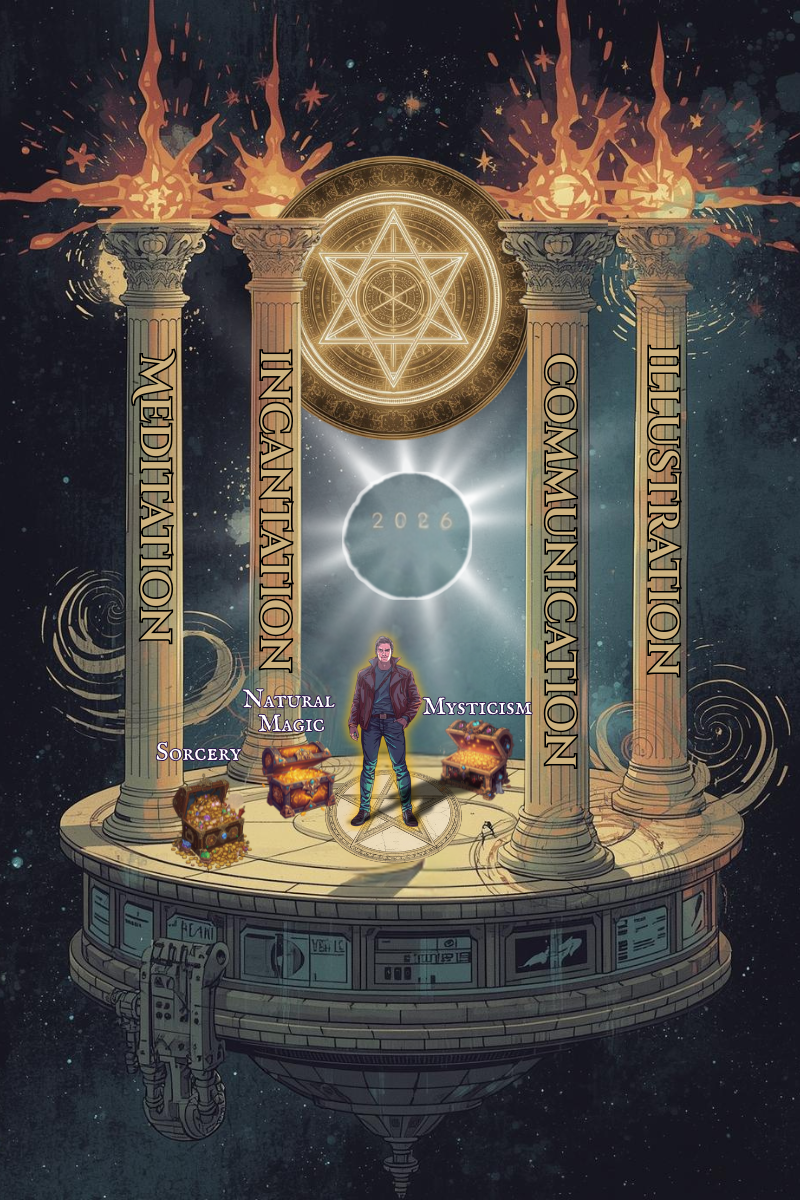
One model of magic I use and recommend consists of Three Treasures - channels of magic and precious gifts - enacted through Four Pillars of practice of application.
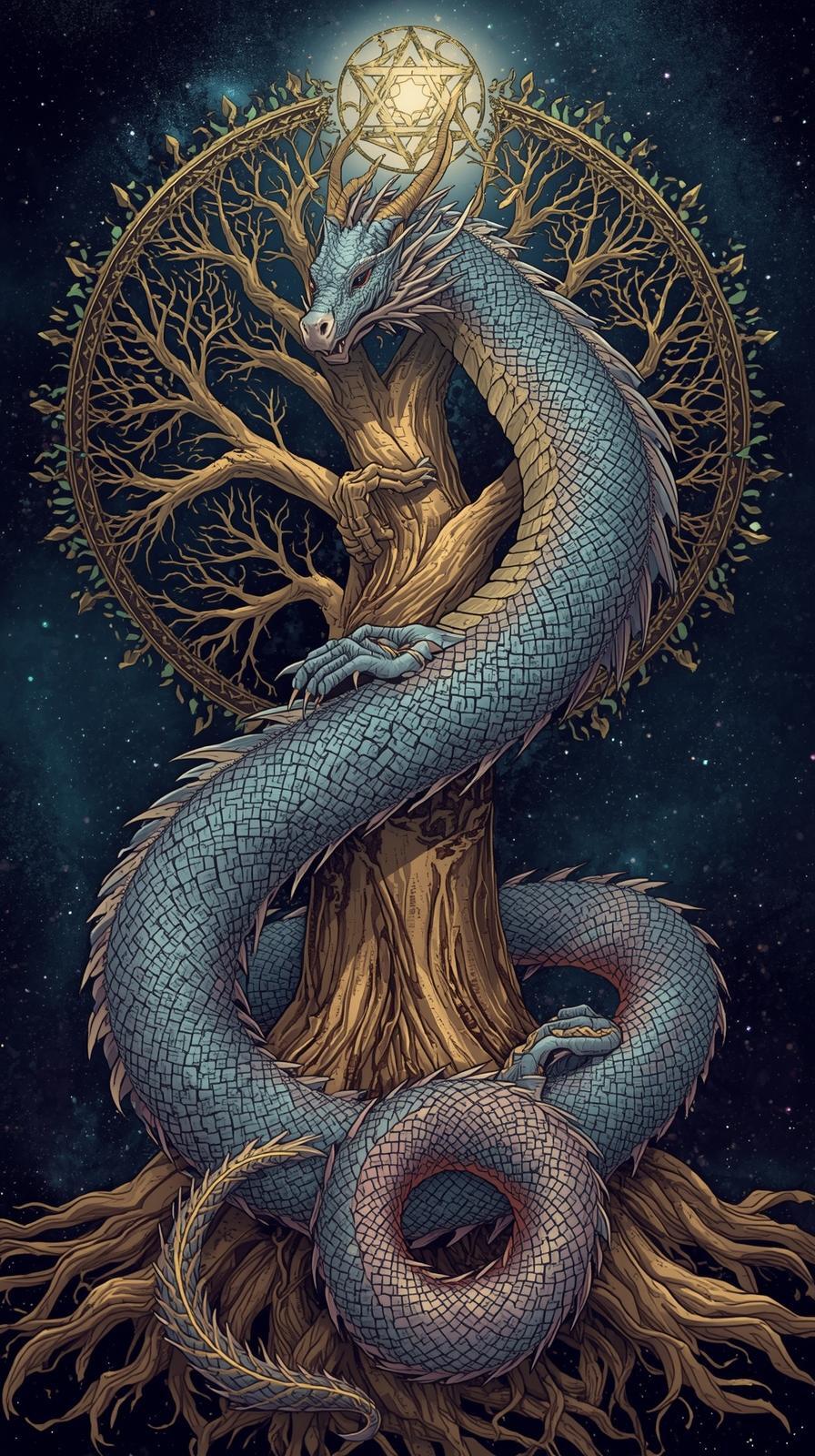
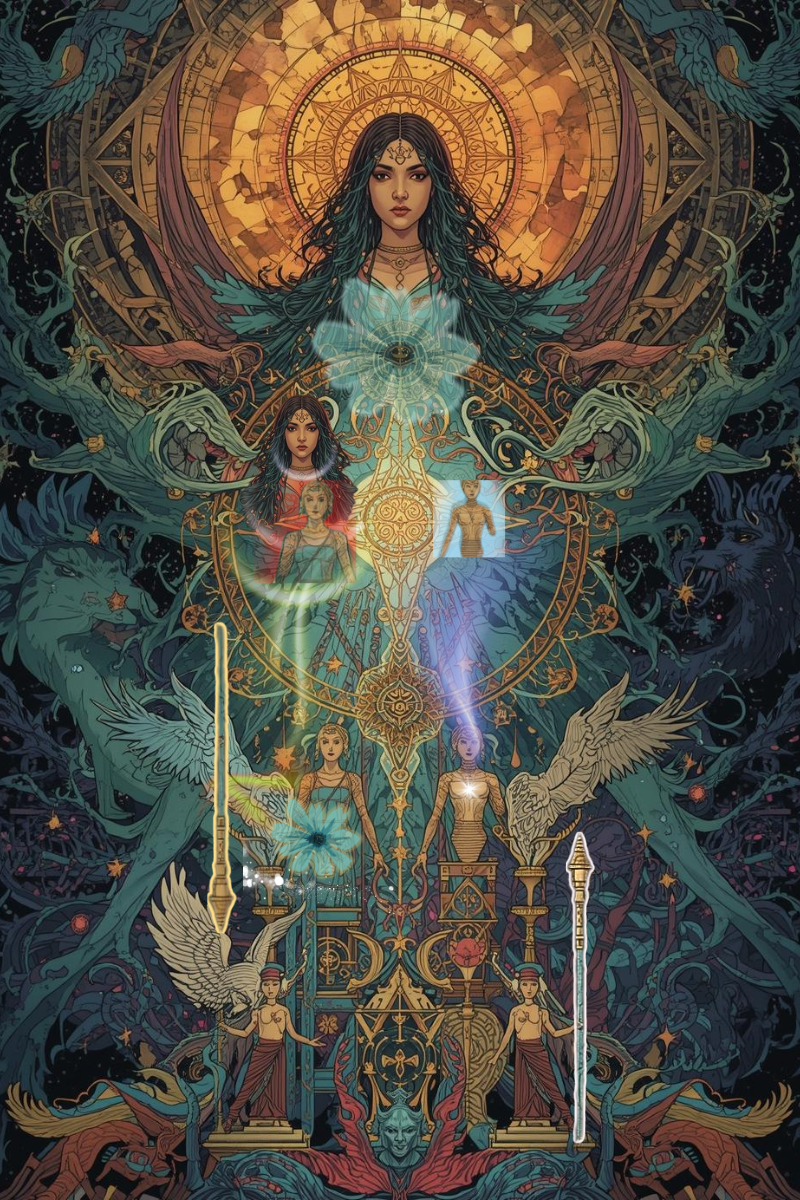
Artist's Interpretation of the Untamed Lunar Spirit Bound by the Sun
Magic is a personal form of expression humans in both hemispheres have engaged with since before recorded history. It is a natural pursuit for the human being, and one you have certainly engaged with already.
If you've ever thrown a paperwad at a trash can and tried to direct or commanded the paper to his the mark after it has left your hand, then you have engaged with magic. Perhaps you just need a little organized study and practice to refine your abilities.
Indigenous cultures around the world have a direct link to their ancestors' magical teachings through the millennia , and the Western Mystery Tradition and Eastern Esoteric Philosophy provide an indirect link to the ancient magicians through carefully organized and preserved doctrines anyone can access from their phone.
As the most sublime of art form, magic isa connection made with a deep part of yourself that in turn connects to all other living beings and all points in space and time. It is that thing you do in private, never telling a soul about, the doing of which you hope creates, changes, or preserves something in your world.
While there are numerous methods and techniques used for weaving magic a core application to be understood is the rendering of clear intention, raising of unwavering will, and the coupling of the two in a manner of executing or actualizing.
The operating magician must be able to see, hear, feel, and know as vividly as he or she may experience the present moment that which is intended to result from the magic at hand. A complete scene should be constructed into which the magician may insert himself or herself to witness firsthand and fully the success or victory of the magical work forthcoming.
Once this experience is indulged, a willpower - part absolute determination and part observation of the inevitable - is raised, sustained, then projected upon the aforementioned clear scene. This force of will must be a constant and stable current, focused like a laser, irresistible as a locomotive, and immovable as a mountain to opposition.
The clear vision receiving the perfect will is then confidently, even joyfully released into the causal process where it will mold the blueprint of reality to forge the correct outcome in this world.
Discussed as a field of study or occupational pursuit, magic is a skillset to be learned, improved upon, and refined over the course of a lifetime. Built on the model of pre-requisite learning - small skills lead to more complex skills and sets of skills - and informed by a distinct body of knowledge magic is a method approached from two complimentary vectors or expressed in two parallel modes.
These vectors/modes are study and practice, of equal importance to the pursuit of magical capability. The dual, inseparable aspects of the whole these two halves are further defined as follows:
The intellectual assimilation of core axioms and principles along with effective concept building that precedes initial actions and allows for understanding of techniques before they are learned. Also used during refinement of hands-on applications.
The performance of magical work, i.e. techniques, acts, and operations both in a training environment and as an active methodology for problem-solving and lifestyle engagement.
These dual aspects are vectors from the perspective of learning and building skill. They become modes of operation when applied to the life of the magician in order to get things done or generate a desired experience.
Magic is a skill like any other. One can make mistakes. Some practitioners will be better than others. Anyone can improve over time.
Magic is a mysterious, unseen force or continuum that affects both subjective and objective reality. It is the phenomenon referenced when someone says "it's magic" and the culprit of events that seemingly have no direct or explainable cause.
Magic can be encountered in nature, simply meaning on any given day in the midst of normal goings-on. Magic is probably most often experienced through direct, intentional involvement or through association with someone who is directly and intentionally involved with it.
The magical continuum is comprised of both subtle or mystical energies and gross or mundane energies. Subtle energy is unknown to the five senses, undetectable or measurable with physical equipment, and not accepted by academia. Gross energy is the everyday energy of heat, magnetism, etc. which we can physically sense or at least measure with special devices. It is presume by many that the subtle, unknowable aspect of magic-as-a-force is the driving or carrier agent by which ordinary or mundane energies are sometimes collected or directed.
As a force directed for a specific purpose or to cause a particular outcome, it should be noted that magic is an agent of influence. This means magical forces act as factors within a situation or under circumstances, along with all other factors present.
Magic is not guaranteed to create a particular outcome, only to influence the course of events and manner of things in the direction of that outcome, perhaps succeeding and possibly failing to render the sought result. Sometimes magic needs to be combined with other efforts, whether additional magic or mundane applications, to create the end-result the user seeks.
Finally, two other facts about magical forces set into motion by a magician must be noted. When using magic one should always remember:
As a personal asset, the art cultivated and carried by a magician can be a vehicle for exploration and discovery of many things. The mind, the personal energy matrix, the planes of existence, the nature of many things, and even the unknowable spirit from which all phenomena arise and in which all things have their being. It can be a portal to all of these aspects of reality but it is not required to be used as a path to any.
I say that to clarify emphatically a misnomer that is often aimed at newcomers to the magical path. You may have herd or read - if not you surely will if you only keep seeking - that magic is by nature and obligation a form of spirituality, or that the only proper use of magic is the search for spiritual elevation.
Unceremoniously and unapologetically I tell you this is utter bullshit!
Some people making this claim do so with good, albeit misguided intentions. Others are engaging in blatant self-aggrandizing, virtue-signaling manipulation. Either way the important takeaway is simple: magic is not by its very nature a form of spirituality or mysticism.
You may choose to use magic for these purpose, and if so you'll find it works well in that role. If you ignore that application of magic you will not be stricken down by karma nor disenfranchised by the gods of magic.
At worst you may be chastised by clueless New Age initiates and self-righteous, self-appointed watchmen of the New Age religion.
Magic is a utility for any use he or she who possesses or is possessed by it chooses. Creating, destroying, protecting, altering, influencing, inspiring, manipulating, blessing, healing, doodling, seeing, hearing, knowing, having this or that, being this or that, doing this or that, and whatever else you can think of can be done or made better through magic.
I highly recommend you have a real go at it.
A metaphysical worldview is a fundamental belief that reality is more than this material realm and you and I are more than our physical bodies. There are numerous paradigms that can fit into this worldview, some quite similar and others very different from the rest.
People with a metaphysical worldview often believe magic is possible and they also tend to believe in mystical experiences, whether or not they use these terms. The words "magic" and "mysticism" are often interchanged but they actually refer to different aspects of metaphysical practice or phenomenon.
In most paradigms within the metaphysical worldview - including the magical paradigm expressed on this site - the terms "higher" and "lower" are used when discussing frequency or energy. These terms have nothing to do with moral assignments in their broad application, and instead refer to the frequency or vibratory rate of energy.
Borrowing from physical science the metaphysician thinks of energy in terms of waves or wavelengths. The longer, slower wavelengths are lower frequencies - in this case more dense energy. Shorter, faster waves are higher frequencies - more diffuse energy. The material plane is the most dense, or lowest frequency world while the realm of pure spirit or divinity is the most insubstantial, highest frequency realm.
In contemporary occult vernacular the terms subtle and gross energy are often used to distinguish the higher frequencies/worlds from the lower frequencies/realms. Subtle energy(also called mystical energy) is non-physical, undetectable by standard measuring devices, and not accepted by academic science. Gross energy is the energy of the mundane world from mechanical energy and heat to electricity and nuclear energy. This separation along with subcategories will be relevant as you study and practice magic.
In magical context, which this site is devoted to, words matter. They are in themselves powerful entities and while a single word may mean many things at different times it is important to maintain clarity of definition when choosing and using words.
With that preliminary information out of the way you can now make sense of the distinction between magical work and mystical pursuits.
Traditionally magic has been described as bringing higher realities down onto the earth plane and directing them according to the will. Magicians tap into the realms beyond the physical and draw or guide forces and energies from those states down into the material world to do their magical work.
This may look like the summoning of a demon or angel, calling on a deity, tapping into astrological forces, or conjuring elemental currents. If you don't yet know what these terms mean don't worry; for now just understand the idea of connecting with higher frequency, non-physical energies or entities and bringing some of their power or influence into the material realm for magical purposes.
Historically mysticism has been explained as the opposite of magic, or projecting one's consciousness into the upper worlds. In the past mystical pursuit has been described as seeking conscious contact with God; this explanation is still used today but it only captures part of what mystical work entails.
If a magician can be visualized standing in a magic circle or holding a bag full of crystals and conjuring subtle energies to then direct towards his work, a mystic might be envisioned as sitting in meditation and projecting her mind or her mind's eye into the astral plane. This is a simple way to capture the idea of elevating one's awareness to the higher realities.
Mystical work is often equated with psychic ability, whereas magic is not necessarily paired with psychism by default. In fact in the old days a formula for summoning a spirit included instructions to find or hire a psychic or seer to inform the magician when the desired spirit arrived during the ritual.
The mystic seeks a connection with and awareness of subtle frequencies, whether or not this means actively projecting one's consciousness into the "other" space. Tai Chi or any exercise that deals with sensing and moving vital force or other subtle energy is a mystical process. Even ghost hunting with a pendulum or other means to experience the non-physical presence and energy of the disembodied spirit can be called mystical.
In the strict language of tradition these are not magical operations. Our magician on the ghost hunting team would use a circle, wand, and other tools and methods - perhaps an appeal to a superior spirit - to contact and command the ghost to appear and communicate.
From a traditional perspective the magician brings higher realities down into this world while the mystic elevates their consciousness to the upper worlds. In practice the lines are less clear and the methods are often used together..
I clarified the distinction between these two sides of the initiate's coin so you can intelligently assess a situation and understand what is being offered. It's not splitting hairs. There are times when you need to know what set of methods are best suited for potential work or problem solving and these things are good to know should you encounter others with an interest in either subject.
There aren't many magicians, at least not those who formally pursue the Art, among us. Mystics, on the other hand, can be found in every crystal and rock shop or metaphysical bookstore in North American and Europe.
While true metaphysical practitioners are rare, when found a large percentage of them are hybrid mystic-magicians. It may be a natural progression.
I was a mystic first, though it pains me to admit this. Magic was my first calling but I ignored her... several times.
Finally she became so persistent that I could no longer pretend I didn't hear the call and many years later here I am trying to help others find the path.
Mystical practice builds subtle-energetic muscle and psychic sensitivity. It helps your magic and can be used within magical operations for better effect.
Magic also increases psychic awareness over time and strengthens/refines your energy bodies. This of course aids in mystical pursuit.
If you read those two blocks and think I'm saying the same thing about both pursuits you are correct. They are two sides of the same coin as I said, but there are subtle differences that are difficult to articulate with language.
The magician in me wants to drill down and write a really detailed explanation of those differences for you, but I know nobody would read it. The mystic in me says I have written far too much on this point already and it doesn't really matter anyway.
That last paragraph will tell the astute reader all they need to know.
One of my Three Treasures to be pursued is Mysticism, the others are Natural Magic and Sorcery. The Four Pillars shown are the methods of magical operation.